It's Nifty Gateway Day For Tommy!
I am very pleased that I was able to _essentially_ hack my way onto Nifty Gateway with a 1/1 auction tonight to go along with the drop of my Open Edition collaboration with PR1MAL CYPHER.
First thing's first, huge thanks to PR1MAL for everything that he's done for the space, and for inviting me to collaborate with him on his latest NG drop. The two of us have a lot of future work to do together!
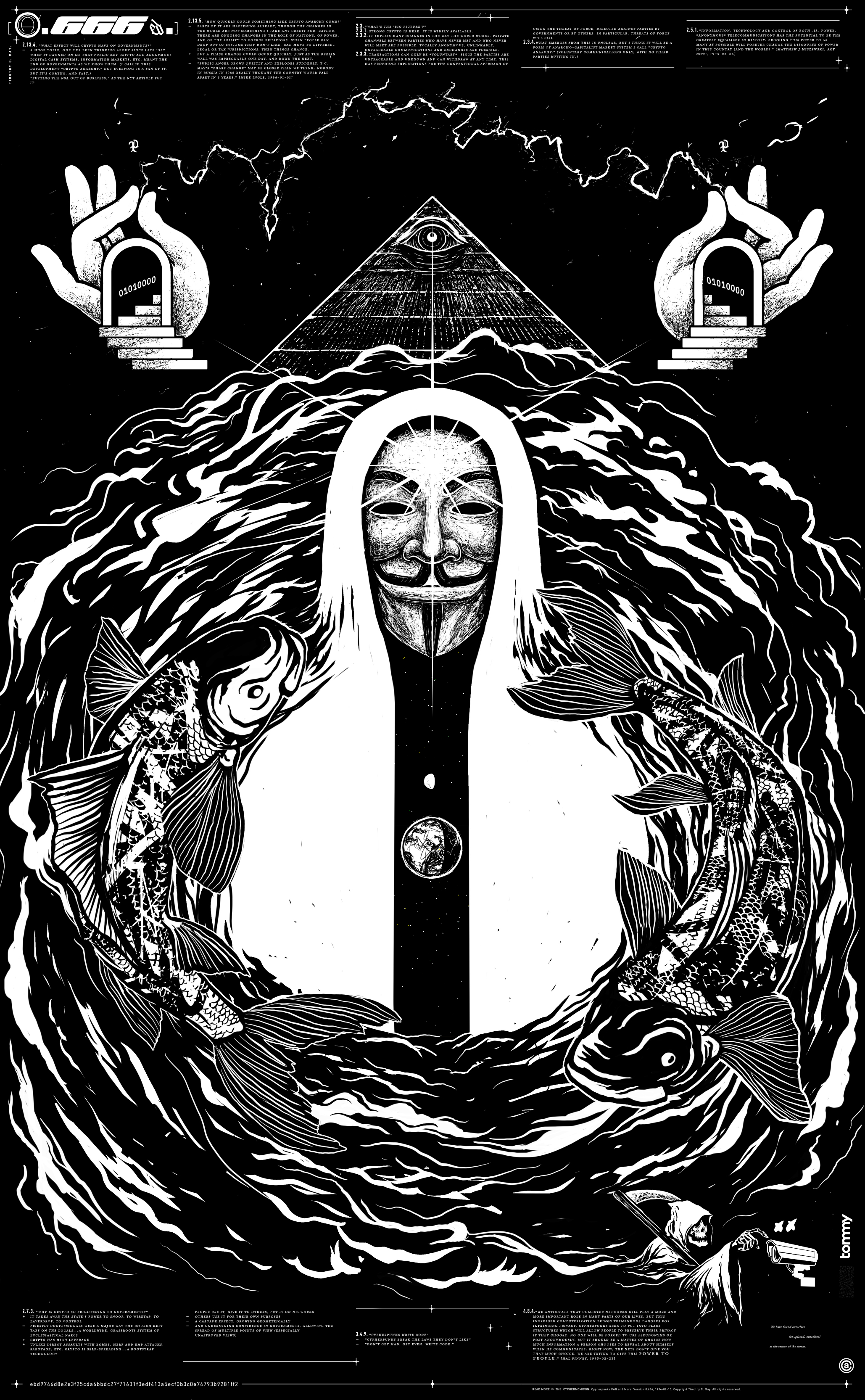
In addition to this collab. piece, I was able to sneak in a 1/1 variant of the piece as a separate auction.
I n t r o d u c i n g :
P2P
1/1 NFT only on Nifty Gateway
4116 x 6660 px JPG
auction starting Monday, 2/1/21 at 7pm ET
(LINK TO AUCTION)
P2P pays homage to THE CYPHERNOMICON published by Timothy May in 1994, including select passages from the text encrusted in the raster. The text reads:
2.13.4. "What effect will crypto have on governments?"
- A huge topic, one I've been thinking about since late 1987
when it dawned on me that public key crypto and anonymous
digital cash systems, information markets, etc. meant the
end of governments as we know them. (I called this
development "crypto anarchy." Not everyone is a fan of it.
But it's coming, and fast.)
- "Putting the NSA out of business," as the NYT article put
it
2.13.5. "How quickly could something like crypto anarchy come?"
- Parts of it are happening already, though the changes in
the world are not something I take any credit for. Rather,
there are ongoing changes in the role of nations, of power,
and of the ability to coerce behaviors. When people can
drop out of systems they don't like, can move to different
legal or tax jurisdictions, then things change.
+ But a phase change could occur quickly, just as the Berlin
Wall was impregnable one day, and down the next.
- "Public anger grows quietly and explodes suddenly. T.C.
May's "phase change" may be closer than we think. Nobody
in Russia in 1985 really thought the country would fall
apart in 6 years." [Mike Ingle, 1994-01-01]
2.3. "What's the 'Big Picture'?"
2.3.1. Strong crypto is here. It is widely available.
2.3.2. It implies many changes in the way the world works. Private
channels between parties who have never met and who never
will meet are possible. Totally anonymous, unlinkable,
untraceable communications and exchanges are possible.
2.3.3. Transactions can only be *voluntary*, since the parties are
untraceable and unknown and can withdraw at any time. This
has profound implications for the conventional approach of
using the threat of force, directed against parties by
governments or by others. In particular, threats of force
will fail.
2.3.4. What emerges from this is unclear, but I think it will be a
form of anarcho-capitalist market system I call "crypto
anarchy." (Voluntary communications only, with no third
parties butting in.)
2.5.1. "Why is crypto so important?"
+ The three elements that are central to our modern view of
liberty and privacy (a la Diffie)
- protecting things against theft
- proving who we say we are
- expecting privacy in our conversations and writings
- Although there is no explicit "right of privacy" enumerated
in the U.S. Constitution, the assumption that an individual
is to be secure in his papers, home, etc., absent a valid
warrant, is central. (There has never been a ruling or law
that persons have to speak in a language that is
understandable by eavesdroppers, wiretappers, etc., nor has
there ever been a rule banning private use of encrption. I
mention this to remind readers of the long history of
crypto freedom.)
- "Information, technology and control of both _is_ power.
*Anonymous* telecommunications has the potential to be the
greatest equalizer in history. Bringing this power to as
many as possible will forever change the discourse of power
in this country (and the world)." [Matthew J Miszewski, ACT
NOW!, 1993-03-06]
2.7.3. "Why is crypto so frightening to governments?"
+ It takes away the state's power to snoop, to wiretap, to
eavesdrop, to control
- Priestly confessionals were a major way the Church kept
tabs on the locals...a worldwide, grassroots system of
ecclesiastical narcs
+ Crypto has high leverage
+ Unlike direct assaults with bombs, HERF and EMP attacks,
sabotage, etc, crypto is self-spreading...a bootstrap
technology
- people use it, give it to others, put it on networks
- others use it for their own purposes
- a cascade effect, growing geometrically
- and undermining confidence in governments, allowing the
spread of multiple points of view (especially
unapproved views)
3.4.9. "Cypherpunks write code"
- "Cypherpunks break the laws they don't like"
- "Don't get mad, get even. Write code."
4.8.4. "We anticipate that computer networks will play a more and
more important role in many parts of our lives. But this
increased computerization brings tremendous dangers for
infringing privacy. Cypherpunks seek to put into place
structures which will allow people to preserve their privacy
if they choose. No one will be forced to use pseudonyms or
post anonymously. But it should be a matter of choice how
much information a person chooses to reveal about himself
when he communicates. Right now, the nets don't give you
that much choice. We are trying to give this power to
people." [Hal Finney, 1993-02-23]
We have found ourselves
(or _placed_ ourselves)
at the center of the storm.
The term "P2P" is almost always assumed to mean "Peer-to-Peer", but in this case we can attach another, equally fitting meaning coined by Hal Finney himself: "Power to People"
Here's one for CYRPTO ANARCHY
READ MORE –– THE CYPHERNOMICON: Cypherpunks FAQ and More, Version 0.666, 1994-09-10, Copyright Timothy C. May. All rights reserved.
Happy bidding!
–tommy (aka Tommy, aka TOMMY)